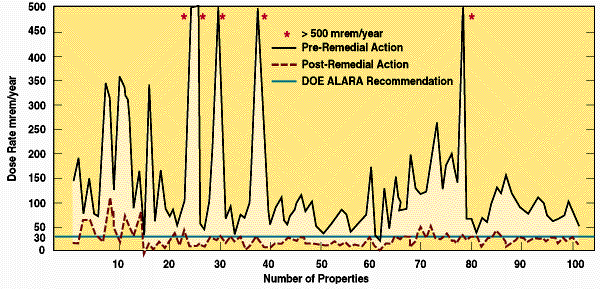

A comparison of dose rates per property is shown for pre- and
post-remedial action in Monticello, Utah.
Does remediation of uranium mill tailings contaminated-properties reduce the risk to residents of those properties?
Pre-and post-remedial action dose rates were calculated for 101 Monticello, Utah, properties
included in the Monticello Vicinity Remedial Action Project. Dose rates were calculated using
the RESRAD computer code. This calculation indicated that 98% of the effective dose
equivalent was contributed by external gamma and radon emanation. Radium concentrations
were averaged for pre- and post-remedial action measurements. The volume of the deposit
was also used in the dose calculations. In all cases the dose was reduced below 1 mSv
y-1
(100 mrem y-1). At 77% of the properties it was reduced below the Department
of Energy's
ALARA recommendation ( 0.30 mSv
y-1).
Pre- and post-remedial dose rates were compared with a paired t-test, which showed a significant difference (reduction) (p < 0.05) in dose rates. The average cost of remedial action, number of persons per household, number of properties remediated, and the reduction of cancer mortality risk through remediation resulted in a cost of $5 million per life saved.

Bengtsson, G., and L. Moberg. 1993. What is a reasonable cost for protection against radiation and other risks? Health Physics 64(6):661-666.
Eger, K. J. 1994. What is the value of human life? Health Physics Newsletter 22(9):8.
Espegren, M. L., G. A. Pierce, and D. K. Halford. 1994. Comparison of risk for pre- and post remediation of uranium mill tailings from vicinity properties in Monticello, Utah. Health Physics (in press).
Integrated Assessment Briefs. 1995. ORNL/M-4227. Oak Ridge National Laboratory, Oak Ridge, TN.