Deep Terrestrial Carbon Sequestration
Objectives
- Develop procedures to monitor and verify the longterm storage of sequestered carbon dioxide in deep subsurface formations as part of the DOE Frio test.
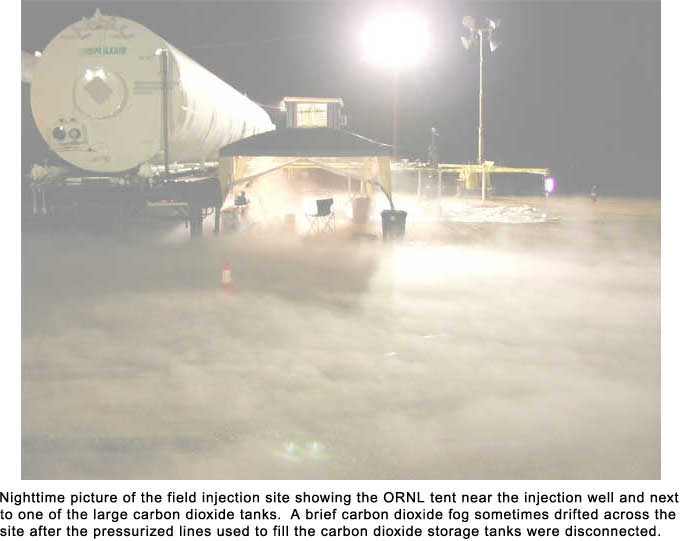
- Demonstrate conservative perfluorocarbon tracers (PFTs) for tracing and monitoring the injected CO2 plume as the plume migrates from the injection well towards the monitoring well.
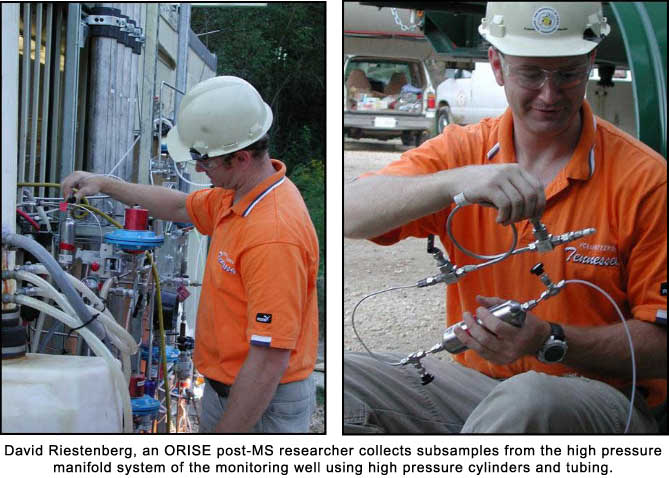
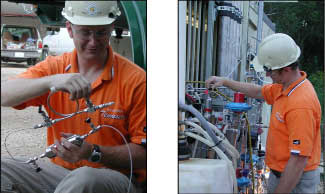
- Develop and describe the methods used to inject, collect, and analyze perfluorocarbon tracers (PFTs) during the Frio Pilot CO2 injection and to report the results.
|
PFT Used in Monitoring Carbon Sequestration in the Subsurface
- The tracers enabled quantification of CO2 plume breakthrough.
- The tracers add value to model validity testing
- PFTs make good tracers because they
- are non-depositing
- non-scavenge
- are non-reactive
- have a low atmospheric background
- have limited industrial use
- have a sensitive detection limit
- Four PFTs used
- Perfluoro-methylcyclopentane (PMCP)
- Perfluoro-methylcyclohexane (PMCH
)
- Perfluoro-dimethylcyclohexane (PDCH)
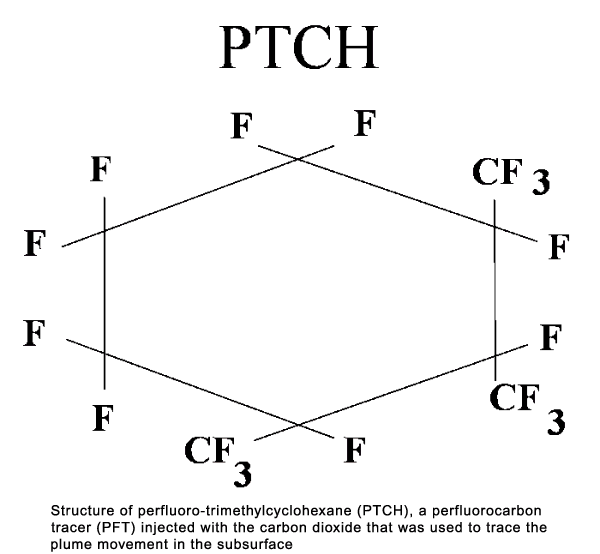
- Perfluoro-trimethylcyclohexane (PTCH)
|
(Click to enlarge)
(Click to enlarge) |
Summary: The use of multiple PFT suites provided:
- Consistent Breakthrough data
- Identification of multiple breakthroughs
- Breakthrough data for simple radial flow model and added value to flow path analyses
- The methods worked well for collecting ~200 samples and is readily scalable upward (1000+)
(Click to enlarge)
Related Links
For more information, contact:
Tommy Phelps (phelpstj@ornl.gov, 865-574-7290)
Tony Palumbo (palumboav@ornl.gov, 865-576-8002)
Revised: 8/11/05
|